Tuesday, January 18, 2011

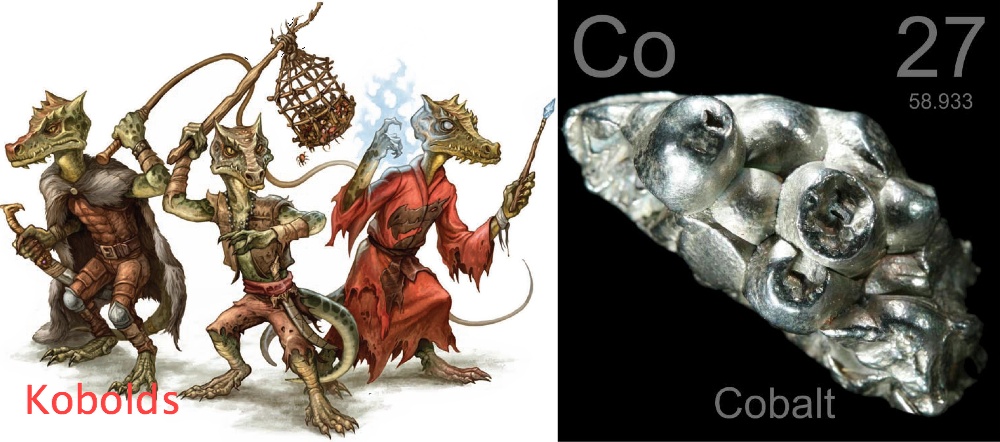
I just learned a fun fact that connects two very distinct fields. A Kobold is a fairly weak, generally stupid civilized creature in the Dungeons and Dragons world. Apparently "Kobold" means "Goblin" in German, and the element Cobalt got its name since miners referred to it as "goblin ore." Who would have thought that there was a relation?

Another bit of intriguing wordplay that came up of late is the hilarious distinction between a flagrantly technical foul and a technically flagrant foul.

I just started reading The Hero of Ages, third and final installment of the Mistborn series. My least favorite thing about this trilogy is that a character I hate continues to gain power and be portrayed in an overly positive light; it is my most sincere hope that he dies a horrible death in the next few hundred pages. There's almost no chance of this happening though. Anyway, I'll write more after I've finished this book. I expect to have all 7 Nausicaa books under my control by the end of the week as well.

Camping plans have yet to progress, except that the pilgrimage has gained followers. I'll try to call the Park and the school's equivalent of the Outing Club later this week to arrange arrangements or plan plans. 

I'm watching my friends play Donkey Kong Country Returns right now, and frankly, its a bloodbath. They've had to continue no fewer than thirty seven times in the first 12 levels. Their riddled ruins lie mangled and strewn across the level known appropriately as Tidal Terror. 

Today I honor another classic movie villain, the unforgettable Wicked Witch of the West!
The most vile creature in all the lands, the Wicked Witch of the West is the main antagonist of the most famous rendition of the Wizard of Oz. After Dorothy lands a house on the Witch's sister, the green hag swears revenge with one of the most famous lines in all of film. The Wicked Witch attempts to foil the protagonist and regain the lost Ruby Slippers with magical spells and even unleashes the most powerful force in the universe on Dorothy and her cohorts: flying monkeys! But honestly, its not like her aggression towards the company is unfounded given the Kansas girl's involvement in the death of the Witch's sister. Unfortunately for justice and for the Witch especially, her weakness is water, and a mere splash is enough to dissolve her into a powerless puddle of vile goop. 

Sunday, January 16, 2011

You might have noticed the new ornamentation on the left sidebar. The Christmas decoration was getting a little out of season, so I pulled the ole' switcheroo with the utmost of extemporaneousness. Yet in time these two/too shall be replaced.

I've always liked how proclaiming that the weather is "FOG" is done with the gusto of three consecutive capitals. It's like the haze just suddenly appears and trumps all other weather patterns: "Today we will have partly cloudy skies with a 23% chance of ... NOPE NEVERMIND IT'S GUNNA BE FOG!" Besides, even if there was some other weather going on, you wouldn't be able to see it.

The elongated weekend has left me with more time than I know how to deal with. So far I've spent it relaxing, watching football and playing Donkey Kong. I'll probably look over some E&M or Quantum Mechanics at some point. Yet I'm left thinking that taking a trip would have been pretty fun. So if I can manage it, President's Day weekend will be spent camping at Yosemite National Park. Given that it will still be in the middle of February, hopefully not too many people will be there, and since President's Day immediately follows our midterms I should be able to round up some physicists to accompany me. I'll start gathering supplies sometime soon.

Random, yet beautiful, coverpage by Oda
Today I bring you another of Eiichiro Oda's colorful villains: Enel!
"Yahahahaha!" Enel is the self-proclaimed God of Skypiea. Since eating the Goro Goro no Mi (Thunder Fruit) he has possessed the power lightening and all that that entails. He can travel close to the speed of light, cannot be harmed by conventional means and can deliver massive electrical shocks at will. Even if felled, he can actually use his power to restart his own heart! Using these alarming abilities he enslaved the people of Skypiea and ruled the land actually believing himself to be a god. So sure is he of his invulnerability, that his shock and feeling of horror when his omnipotence fails him is extreme to say the least.

Thursday, January 13, 2011

During a Quantum Mechanics homework extravaganza, some of my Physics friends and I found ourselves talking about our disappointment with our latest sushi excursion. Naturally this made us quite hungry and deciding quickly that seafood was tastier than iterated integrals by parts, we grabbed our stuff and headed for yet another raw-fish purveying establishment, Sushi Nobu. It was flat-out magnificent. The service was unmatched, the variety fantastic and the freshness supreme. One had but to utter the name of any among a myriad of items and the succulent creation would appear in seconds. And so beautiful was each dish that each time one of the chefs handed you one of his glistening, colorful formulations of cuisine, the eyes were sure to feast as much as the stomach. I will be sure to return.

If you have any interest in thematic fungi, I highly recommend clicking on the following image:

My time has recently been spent pretty solely on homework. In anticipation that I may have freetime this weekend (Martin Luther King day extends it), Amazon has now provided me with the last book in Sanderson's Mistborn trilogy, the first in Steven Erickson's recent epic, and the start of Hayao Miyazaki's manga creation. I might just end up sleeping, playing racquetball and watching football though. It's hard to say at this point.

I really should get out my new digital camera and take some pictures of something. Perhaps early next week. Speaking of early next week, I've been cunningly lured into a talk on information theory by the tantalizing promise of pizza.

Today's villain is possibly the most famous non-Star -Wars robot of all time: HAL9000.
Arthur C. Clarke's 2001: A Space Odyssey is one of the most well-known science fiction novels ever written and Stanley Kubrick's brilliant film adaptation ensures that the story of HAL9000 will not soon be forgotten. Two astronauts (and a sleeping crew) are aboard a spaceship headed for Jupiter, millions of miles from any other living being. Their only companion is HAL, the ship's computer. Along with Kubrick's depiction of HAL's sensors as malevolent and omniscient red eyes, its chilling monotone conveys the uncaring, systematic nature that makes the threat and tension all the more pronounced. When the men attempt to disconnect the him due to irregularities (caused by Earth's insistence that HAL lie to the crew about the mission), this threat becomes real and HAL tricks one to his vacuum-induced doom then sucks the rest of the sleeping crew into the black void of space as well, leaving only David Bowman alive. Bowman destorys HAL in an extremely emotional death scene wherein the computer acts more human than many of the movie's characters.

Sunday, January 9, 2011

The origins of units came up during our TA meeting the other day, and I thought I'd quickly outline the definitions of some of the more common units we use today. I apologize for thinking that this is interesting.

-Second: At first the sun defined the second in that it was one 60th of a minute, which was one 60th of an hour, which was one 24th of a day. Today the scientific definition for the second is the amount of time it takes a caesium 133 atom to oscillate 9,192,631,770 times. This is actually how atomic clocks keep time. It's quite exact. Of course, now we have to add leap seconds every now and then to keep the sun consistent with our caesium.

-Meter: Originally defined as the length of pendulum whose period of oscillation is 2 seconds, it was later changed to one ten millionth the distance from the Earth's equator to the North Pole. Now we define the meter as the distance that light in a vacuum travels in one 299,792,485th of a second.

-Kilogram: My personal favorite. This unit was originally defined as being the amount of mass in one liter of water, but it has a much more interesting meaning now. On the outskirts of Paris lies a mysterious institute known as the International Bureau of Weights and Measures. Deep with the confines of this complex lies a fortified, climate controlled vault; three simultaneous keys must be turned to gain access to this most hallowed of places. Inside, probably gleaming brighter than the pedestal of gold on which it surely must stand, lies a treasure beyond wealth: in hushed, furtive tones the French name it "Le Grand K." It is the International Prototype Kilogram, and the amount of mass in this physical object is actually the scientific definition of the kilogram. Since any change in this quantity would actually affect all of science, the most stringent of constraints are imposed to prevent such devilry: it was constructed as a sphere made of a platinum-iridium alloy to minimize surface area, thermal conductivity, magnetic and electrical susceptibility, and prevent oxidation. And no, I did not make any of that up.
A replica of a replica of Le Grand K that is owned by Denmark
Enough about units, but more about the French. Yesterday I watched a humorous movie that originated in that country entitled A Town Called Panic, which uses some fascinating stop motion, hilarious voice acting, and a cast composed of plastic toys to tell a delightful tale of misadventure.

We went to a new place for Sushi called Jusco Sushi Buffet yesterday, and overall it was a disappointment. It was "all-you-can-eat" in the sense that you could keep ordering food without paying more, but the rate at which the cuisine was delivered precluded any such intentions. It was still quite tasty though. This week will be my first real week back. I teach twice and homework is due in every class. Hopefully I'll be able to get some stuff done today other than Donkey Kong levels.

With nothing else to say I shall cut to the chase. Today I introduce the antagonist of Kentaro Miura's spectacular manga Berserk. His name is Griffith.
Griffith is the leader of the Band of the Hawk, a troop of mercenaries that is renowned for its prowess and skill. He is a master swordsman, a brilliant strategist and his charisma is irresistible. His country views him as a hero, yet beneath his radiant exterior lies a cold, black heart filled only with ambition. After losing for the first time in his life to his friend and the protagonist Guts in a duel, Griffith loses control and is eventually captured and tortured by the ruling government. Even after being freed by his friends in the Band of the Hawk, he receives an offer to become a demon and has no problem accepting and achieving his dream from atop the corpses of his comrades; he commits the ultimate betrayal and slaughters all but two of the Band for his own desires. As a near-divine being he now conquers his way across the lands, daring to lead a new Band of the Hawk and is sought by the revenge-minded Guts.

Friday, January 7, 2011

Well, the holidays are over, and I'm back in California. Classes have begun anew, and in addition to teaching again this semester I shall endeavor to locate an advisor with whom I can do some interesting research. I've had some free time so far while my professors get their brass knuckles out, and I have mostly spent it playing Donkey Kong Country Returns (a delightfully diverse and challenging platformer) and finishing up a series of books I had been reading during my flights. More on the book series below. Fantasy novels are my preferred way to pass the usually boring time.

Did you know that if we cut a tunnel into the Earth's crust, through the mantel and then out the other side, one could (ignoring friction) hop in such a tunnel and, thanks to gravity, be on the other side of the planet in just 42 minutes? In fact, the magic of the conservation of energy mandates that ANY destination on the Earth's surface would be a 42-minute hop away. Pretty nice, huh?

Robin Hobb's Farseer Trilogy  has quite a bit less assassination that the titles of its books seem to imply (Assassin's Apprentice, Royal Assassin and Assassin's Quest). The first book is a fairly average affair about a royal bastard with a stereotypically-mysterious past growing up amongst the nobility who, as usual, are fighting for the control of the particular country he lives in. There is a bit of magic involved and a lot of intrigue, but nothing about the book really stands out except perhaps the disappointingly lackluster ending. The second book features the same main character doing virtually nothing for a long period of time, and is saved only by the author's unconventional decision to have the vast majority of the book take place in a single building and a surprising finale. I wouldn't have bothered typing so much about this series if the final book hadn't broken this mold of mediocrity. You see, the main character dies at the end of the second book, and things only get more unusual from there. Although it seemed like a lot of time was wasted in the first two books, I really felt like I understood how the main character felt during his final quest because of that enormous amount of seemingly repetitive interaction he had with the small cast of characters in the previous books. Its quite engaging, little about the end of the series is normal for fantasy, and it really makes you think about characters who aren't perfect, glitteringly heroic superheros. I didn't expect to have to think as much as I did, either.

I've read the first two book's in Brandon Sanderson's Mistborn series so far, so I'll probably get around to talking about that series when I finish it's final installment. So far I would critique that he put a lot more thought into his magic system and over-arching plot than the minutia that really make a series worthwhile.

I guess I need to take care of the Christmas ornament on the side of my blog. I'll put something else there in a bit. In fact, it will probably have changed by the time you're reading this possibly worthless sentence.

In the meantime here's a classic villain for your enjoyment: Angel Eyes.
His heart is as black as his hat. Lee Van Cleef plays "the Bad" in The Good, The Bad and the Ugly, one of the greatest Westerns (and movies) ever made. Angel Eye's introduction is a spectacularly grim scene that leaves little doubt that the movie has cast him correctly: the gunslinger murders a man for money, kills that man's family for the fun of it, and then laughs (as seen in the image above) as he eliminates his employer following the chilling line, "but you know when I'm paid, I always see the job through." No low is too low for Angel Eyes as he extorts, tortures and murders he way around the old West, vying with the other eponymous characters for a hidden stash of gold.

Thursday, December 30, 2010

A popular (and quite enjoyable) New Year's tradition in Austria is that of Bleigiessen, meaning "lead spirits" in English. In the waning hours of the old year, each participant melts a lead figurine over a candle and then tosses (individual techniques and strategies vary, but I'm a fan of a violent flick of the wrist) the molten metal into a pot of cold water, where it solidifies into its final guise. This unique artifact supposedly grants good luck to its creator for the new year and some say that a legendary Bleigiessenmeister can even preform metallurgical prognostication based on the item's shape.
For a short time I wondered why Wachsengiessen (wax spirits) wasn't a viable alternative. I mean, wax can be shaped into figures, melts easily, and will certainly solidify when cooled, so why not? Throwing tradition and forethought to the wind I gave it a try and it turns out there is a very good reason no one does Wachsengiessen. Wax floats! A flat pancake is invariably created on the surface of the water by the ritual! I earnestly hope that I am not now haunted by enraged, Germanic spirits.

But before being concerned with what is yet to come, yet us linger on times already passed. Winter's grip on the land intensified in the last few days and so in the spirit of doing as little as possible during the holidays my brother, cousin and I bunkered up in the basement with our woodstove, some videogames and a bunch of terrible movies. We may be the first people to ever watch all three Santa Clause movies in a row (it's a diabolically mind-rending task). Our slack-a-thon also included Christmas favorites Jingle All the Way, Home Alone and Home Alone 2: Lost in New York. Believe it or not, these movies were actually a step up from Dungeonmaster/Ragewar and G.I. Joe: The Rise of Cobra that my brother and I watched earlier this week. Between films we enjoyed the masterfully crafted and surprisingly challenging barrel-filled antics of Donkey Kong Country Returns.

I also managed to play through Link's Awakening in the past week. Although its system for assigning but two of the items in your arsenal at a time to buttons now seems barbaric, the game still is quite enjoyable. At first Link's quest in this game seems to be a pretty normal affair wherein he will tromp through a few dungeons and gather a set number of some item (mystical instruments in this case) by smashing a boss in each of these locales in order to achieve some final goal (waking the legendary Windfish). Yet as he goes about this task he receives the cryptic musings of a strange owl and warnings from the bosses (dubbed Nightmares) he slays about "waking from the dream" and the island being an illusion created by the slumber of the Windfish. It's quite poetic. The Windfish himself though looks a bit like a whale whose owners make him wear the most ridiculous clothing and ornamentation that they can find. Look at his eye. Does that look like a happy aquatic mammal to you?
Tal Tal Heights has some incredible music too.

Well, I've been promising him for a while now and he's really only a villain in vaguest sense, but without further ado I present Aresene Lupin III!
Lupin III is an infamous rogue, insatiable scoundrel, and the world's greatest thief. Hounded across the globe by Inspector Zenigata, Lupin seeks out adventure and challenge to his ability as much as wealth and treasure. I may have mentioned that some of my previous villains had some skill in impersonation, but Lupin is the unparalleled master of disguise. His guile is world-renowned and his only weakness is for the beautiful Fujiko, a sometimes-friend-sometimes-enemy who usually attempts to exploit Lupin's soft spot for her by grabbing the goods at the last minute. Lupin can't really be considered evil and his attitude and debonair make him the prince of gentleman thieves. And did I mention his fantastic theme song?

Thursday, December 23, 2010

Merry Christmas! Well, almost.

Gamefaqs just recently completed its Game of the Decade contest, determining by popular vote that the greatest game to come out between the years 2000 and 2010 was The Legend of Zelda: Majora's Mask. I have no desire at all to disagree with this assertion, but picking a single game is far too difficult for me. On the other hand, if I had to name the best five games of the decade I would put forth Majora's Mask (2000), Paper Mario (2001), Metroid Prime (2002), Windwaker (2003), and Mother 3 (2006). 

There is a certain manga that I truly love, its title is Mudazumo Naki Kaikaku, and its awesomeness knows no bounds.
The man on the cover is the manga's protagonist, Junichiro Koizumi, actual former prime minister of Japan. You see, this manga proposes a world exactly like the our own, except that throughout history political disputes were handled not through diplomacy, but through mahjong (an oriental gambling game that can perhaps best be equated to bridge or poker). Ridiculous special attacks and famous world leaders appear (Bush Senior, George W. Bush, Vladimir Putin, and even The Iron Lady to name a few) and each is more badass than the last (except Sarkozy, who is often the butt of jokes). Even Pope Benedict gets in on the action. Prime Minister Koizumi's ultimate technique is the Rising Sun (it has been animated as well), and combined with his many cheats and bluffs he fights valiantly for the Japanese people.

Who better to be the villain of this series (and consequently of this post) than one of history's most evil leaders: Adolf Hitler.
I will not speak of Hitler's historical atrocities, but only of his additional actions within the manga. Instead of committing suicide, Hitler escapes Germany by way of submarine to fight again another day. Cardinal Ratzinger accidently aids the tyrant's flight and vows to defeat him after he ascends to the position of Pope Benedict. Hitler bides his time, and ends up establishing the Fourth Reich on the Moon! To stop him from destroying the entire Earth, the Group of 8 sends its elite mahjong players to defeat him and his Nazi cohorts. Of course, being one of the most evil despots of all time, Hitler's mahjong prowess is unprecedented; the Fuhrer's ability is such that he need not even play a hand to win it, he can see the very fabric of reality and know what events will unfold. Worse yet, when taxed he can take the form of the legendary Super Aryan, capable of untold mahjong feats. Koizumi and his political companions are currently locked in furious battle against the menace of Hitler with the fate of the free world in the balance!